Ilion High School - Class of 1974Herkimer Evening Telegram - September 22, 1973Two Cents a Loaf? Ecuador Bread Prices Low, Ilion Girl FoundArticle 35Source pdf file is here Herkimer NY Evening Telegram 1973 02221.pdf on fultonhistory.com
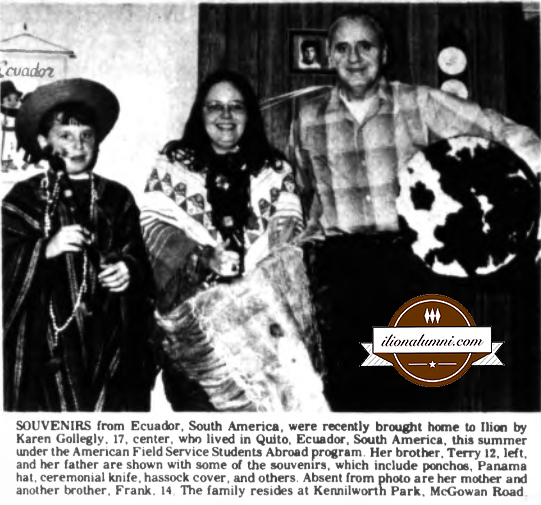
photo caption - SOUVENIRS from Ecuador, South America, were recently brought home to Ilion by Karen Gollegly, 17, center, who lived in Quito, Ecuador, South America, this summer under the American Field Service Students Abroad program. Her brother, Terry 12, left, and her father are shown with some of the souvenirs, which include ponchos, Panama hat, ceremonial knife, hassock cover, and others. Absent from photo are her mother and another brother, Frank. 14 The family resides at Kennilworth Park, McGowan Road.
Two Cents a Loaf? Ecuador Bread Prices Low, Ilion Girl Found BY BOB KELDER ILION - Bread-lovers of the valley area may be interested to know that Karen Gollegly, of Ilion, knows where to buy top quality bread for only two cents a loaf. The place is Quito, Ecuador, South America, where Karen lived two months this summer as part of the American Field Service Students Abroad program. "It's the best bread I ever tasted," enthused Karen "It was so crispy. I wished I could have brought some home." Karen, 17, a senior at Ilion High School, is daughter of Mr. and Mrs. Frank Gollegly, Kennilworth Park, McGowan Road. The bread was only one of the many food items that caught Karen's fancy. She liked mora juice, made from a berry like raspberries, the homemade soup at every dinner, fried bananas, and a delicious yellow fruit called papaya. Steak was an every-day event, as it was very inexpensive, she noted. "Dinner from 1 p.m. to 3 p.m. was the main meal, and supper was just a coffee hour." Karen stayed with the Alberto Marin family in Quito, some 15,900 feet above sea level. It took her a couple of days to adjust to the high altitude. Once adjusted, however, there was no stopping Karen's ventures into high places. She was one of only two students who climbed to the 17,000 ft. snow line of Cotopaxi, a 19,700 ft. active volcano near Quito. The other 17 students fell out because they couldn’t take the altitude. Americans who take their electricity and drinking water for granted, might be interested to know that these are not so readily available in Ecuador. "Once a week, from 10 a m. to 10 p.m., there was no electricity," Karen reported. As for water, the supplies come from snow melting in the mountains above Quito, and there were some shortages. Also, an American buying a new car might be surprised to find that a $3,000 auto costs about $12,000. This is for the small size. Most autos in Ecuador are smaller than most U.S. cars. Karen said The English Ford and Mercedes Benz are popular. The local student said she noticed quite a few 10 to 12 year old boys employed at construction sites around the city, or working as household servants. Apparently, such boys drop out of high school early. However, if they finish high school, the university system is free. "I liked the open markets," Karen said. "People from the farms sell their products there. They raise the price when they see an American Trading there helped me learn Spanish." Inflation is a lively topic for discussion in Ecuador, she found. The people felt they had inflation, but Karen felt they didn’t, when she compared their prices with ours. For example, 25 cents seemed to her to be a cheap price to pay to see a soccer game, that country's version of football. Karen said the teams were good, as it is one of the number-one sports in Ecuador. Asked how she felt on departing from Ecuador, Karen reached into her Spanish vocabulary. "I hated to say adios I had a wonderful time The people were very friendly."

Created and maintained by Aileen Carney Sweeney - Class of 1974
Digital Image Copyright & Copyright © 1997 - 2024 ilionalumni.com
|