Ilion High School - Class of 1914The Ilion Citizen - June 25, 1914Commencement ExercisesArticle 5Source pdf file is here Illion NY Citizen 1913-1916 - 0512.pdf on fultonhistory.com
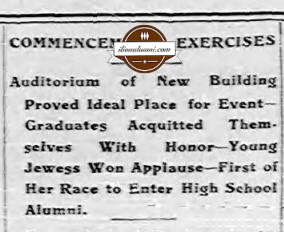
Commencement Exercises Auditorium of New Building Proved Ideal Place for Event --- Graduates Acquitted Themselves with Honor Young Jewess Won Applause --- First of her Race to enter High School Alumni The graduate looks forward with pleasure to the time when school cares can be thrust aside, and they make their appearance before their relatives and friends at their graduating exercises, but none have looked forward to such an event with more pleasure than the class of 1914, Ilion High School, which class will be remembered as being the first to hold its exercises in the auditorium of Ilion's magnificent high school, which was viewed by many for the first time Tuesday evening. The auditorium, seating over 600, was filled, all of whom were delighted with its appointments and pleased that in the future it would be used for similar events and others of an educational nature. Though the evening was extremely warm the splendid ventilation kept the air pure and cooled. The front of the stage was tastefully trimmed with ferns and daisies, and also supported the banner of the class bearing the motto, "Know Thyself," in the class colors of green and gold. On the stage were seated the Board of Education, members of the faculty and Rev. C. H. French, while the members of the senior and junior classes occupied seats facing the stage. The music of the evening was furnished by the high school orchestra of 10 pieces, under the direction of Miss Hulburt, director of music in the Ilion schools, and the music rendered by these young students came as a revelation and bespoke much for their director. The exercises opened with the invocation by Rev. C. H. French. Stanley M. Gordon was the first speaker, taking as his subject, "Steel, a Factor in Civilization." Mr. Gordon with almost easy and clear delivery traced the steel industry from its infancy, showing its many varied uses and its effect in the growth and development of the world of today. Miss Arlene M. McDonald, in her subject, "The Problem of the Rural School," showed that in the advancement and development shown in the graded schools, the rural schools were forgotten, and made a plea for its development, stating that the school house of yesterday was not the school for today. She advocated centralized schools in rural communities and showed the value of such. Miss Mary R. Carney made a plea for her sex in her essay, "The Long Road," showing the advancement made in the last 2,000 years by women, and the ability of woman to take her place in the affairs of today. She urged an appeal for the ballot for women that they might take their place along aside of men in an effort for better government. After the selection, "Bridal Rose," by the orchestra, Miss Flora W. Davies gave a most interesting essay on "The French Revolution," depicting in an interesting manner the cruelties and suffering leading up to it. Miss Ruth Markley advocated "The Abolition of Capital Punishment," stating that capital punishment does not coincide with Christianity, and that while science, literature and art have reached their highest plane, laws regarding capital punishment remained the same. Miss Edith M. Staring, in her essay, "The Magnified School," showed the need and good to be accomplished by using the school as a social center and urged that Ilion's new school be used for the starting of such a movement, a place where matters pertaining to art, civic improvement, literature and music could be discussed by all on the same footing, and the benefit to be derived by the young people in such a movement. The orchestra rendered "Idyl D'Amour," after which Miss Luella M. Roberts, well known for her ability, gave an innovation in her essay on "The Growth of Music in America" by playing selections illustrating the growth of music from the early Indian days, the psalm singing of old New England, folk songs of the south and through to the present day. She paid high tribute to the composers of America and the musical training to be received in this country. The next speaker, Miss Lena R. Schwartz, received hearty applause in her essay, "Jessica and Rebecca." Miss Schwartz is the first person of the Jewish race to graduate from the Ilion schools and her defense of her race took much courage and won for her many warm friends. It was an essay of courage and could not be improved upon. Fred S. Reese was the last member of the class to speak and his oration was "The Need of Leadership," which subject was handled in a clear, concise manner, in which he showed the qualifications needed for true leadership and which qualities were sadly lacking in many of the leaders of today. He urged that we profit by the errors of our ancestors and cherish, not crush, our great men. Superintendent of Schools H. M. Schwartz spoke words of advice and wisdom for the class to think and dwell upon in later years and announced the class hors, the recipients receiving much applause: Valedictorian, Fred S. Reese, school average, 95.3-10 Regents average 94 8-10; Salutatorian, Miss Mary R. Carney, school average, 92 8-10, Regents average, 90 1-10; class average, school average 84 2-10, Regents average, 79 6-10. Mr. Schwartz introduced Miss Loretta Douglas, principal of the High School, who addressed the class in a congratulatory manner, giving good advice while so doing, and then presented to the graduates their diplomas. They were received as follows: Latin course, Scientific, English, Elective
Class Sermon The Rev. L. R. Benson, rector of St. Augustine's Church, Sunday morning, preached the baccalaureate sermon to the graduating class of the Ilion High School. The speaker compared the situation of the class with that of the Israelites on the bank of the River Jordan at the beginning of a new chapter in their life book. He referred to "red and blue" courage found under dramatic conditions like a battle or a catastrophe, and also to the "gray" courage which is in itself the only reward the exerciser gets, with no newspaper or public recognition. (Note - Burt D. Hawks was listed as Hawkes in the 1925 Alumni book) (Note - Vernon Gifford, Elliot Lester, Jr., Francis Lewis and John Johnson were not included in this article)

Created and maintained by Aileen Carney Sweeney - Class of 1974
Digital Image Copyright & Copyright © 1997 - 2022 ilionalumni.com
|