Ilion High School - Class of 1909The Ilion News - June 24, 1909C. D. MOSSBL, EDITOR AND PROPRIETORCOMMENCEMENTArticle 4Source pdf file is here Illion NY Citizen 1909-1910 - 0137.pdf on fultonhistory.com
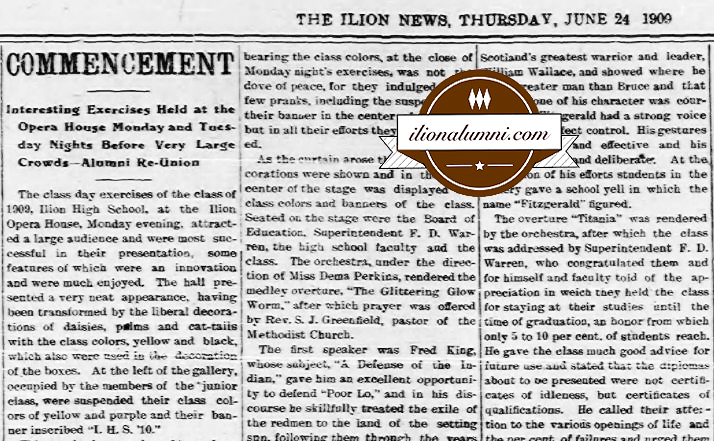
COMMENCEMENT Interesting Exercises Held at the Opera House Monday and Tuesday Nights Before Very Large Crowds - Alumni Re-Union The class day exercises of the class of 1909, Ilion High School, at the Ilion Opera House, Monday evening, attracted a large audience and were most successful in their presentation, some features of which were an innovation and were much enjoyed. The hall presented a very neat appearance, having been transformed by the liberal decorations of daisies, palms and cat-tails with the class colors, yellow and black, Which also were used the decoration of the boxes. At the left of the gallery, occupied by the members of the junior class, were suspended their class colors of yellow and purple and their banner inscribed "I. H. S. '10." This year's class numbers 34 members and has the proud distinction of being the largest class ever graduated from the Ilion High School, the next largest being the class of 1893, which numbered 26 members. The exercises opened with a selection by the orchestra under the direction of Miss Dema Perkins, which was followed by singing of the class song by the class. Following the song, Harold Jarvis, president of the class, made a very strong address, in which he made frequent mention of the class and the happy days that they are now leaving behind.
Commencement Program - Tuesday Evening Music. Orchestra, directed by Miss Dema Perkins Prayer. Rev. S. J. GREENFIELD Oration. "A Defense of the Indian" FRED KING Oration. "Andrew Carnegie's Use of His Money" MAY JARVIS Oration. "The Need of Larger Navy" ARTHUR ROBERTS Music. Orchestra Oration. "The Corsican's Ambition" WESTLEY INGERSOLL Oration. "The Kindergarten" LAURA CHANDLER Oration. "The Power of a United People" HAROLD RUSSELL Music. Orchestra Oration. "What We Owe to New England" SELENA HOUGHTON Oration. "Scotland's Greatest Hero" JAMES FITZGERALD Presentation of Diplomas BENEDICITON - REV. H. E. PIKE Music. Orchestra
Following Miss Greenfield the class presented two acts from the tragedy "Julius Caesar," with the following cast: Brutus, Ray Shaul; Cassius, Leland Quinlavin, First Citizen, James Fitzgerald, Second Citizen, Westly Ingersoll; Third Citizen, Arthur Roberts; Fourth Citizen, Bernard Tracy, Anthony, Clyde Knandel. The class interpreted the lines in a manner that showed their conception of the characters and the careful training received under Miss Loretta Douglas of the high school, who had the class day exercises in charge and also drilled them in the comedy later presented. There was another selection by the orchestra, after which the class quartet, consisting of Knandel and Shaul, tenors, and Roberts and Russell, bassos, sang a selection in a delightful manner. The comedy, "Three Chauffeurs," was what its name implied and was full of humor and catchy situations throughout and each and all assumed their parts in a mariner that won much applause. The cast: Kitty Kennedy, Rachel Jencks; Lorry Spencer, Harold Russell; Marvin Hunter, Fred King; Mrs. L. Spencer, Lulu Barnes; Gertrude Castleton, Olive Williamson; Lois Drummond, Elizabeth Dutcher; Jane Armstrong, Elizabeth Matthews; Lucile Berverly, Jessie Pratt; Minta Morris, Anna Kellner; Eugenia Allen, Eva Hempstead; Mary Smith, Blanche Burdick; Patience Primrose, Floy Brown; Mrs. Spencer, Blanche Ingalls; Lieut. Beverly Churchill, U. S. A. Harold Jarvis; Nora, Selena HoughtOn; Annie, May Jarvis; directress, Miss Douglas. The exercises closed with the singing of the "Alma Mater" by the class. Commencement The Ilion Opera House was filled to its capacity Tuesday evening at the commencement exercises of the largest class ever graduated from the Ilion High School, numbering 34, of which 15 were young men, a large percentage in this age, when so many arc leaving school to enter the various trades and speaks well for the controlling element and home persuasion that holds them in school to fit themselves for the higher professions of life. The date of commencement always seems to come on the warmest day of the year, and this occasion was no exception. The juniors, who occupied the boxes, showed that the dove they liberated, bearing the class colors, at the close of Monday night's exercises, was not the dove of peace, for they indulged in a few pranks, including the suspension of their banner in the center of the hall, but in all their efforts they were thwarted. As the curtain arose the tasteful decorations were shown and in the deep center of the stage was displayed the class colors and banners of the class. Seated on the stage were the Board of Education, Superintendent F. D. Warren, the high school faculty and the class. The orchestra, under the direction of Miss Dema Perkins, rendered the medley overture, "The Glittering Glow Worm," after which prayer was offered by Rev. S. J. Greenfield, pastor of Methodist Church. The first speaker was Fred King, whose subject, "A Defense of the Indian," gave him an excellent opportunity to defend "Poor Lo," and in his discourse he skillfully treated the exile of the redmen to the land of the setting sun, following them through the years that have lapsed, their humiliation their position in the civilization of United States to-day. "Andrew Carnegie's Use of His Money," was the theme on which Miss May Jarvis had written a very strong oration. She told of the distribution of his wealth, showing that by the donation of libraries throughout the country he was making the country more intellectual and that these gifts were the greatest and the best, and she spoke of the good that the library given to this village by its former resident had done. Arthur Roberts was the next speaker taking as his subject "The Need of a Larger Navy." He made a comparison of the foreign battleships and our own and the defects of some of the present battleships. The need of keeping a watchful eye on our foreign possessions and our coast liens was given attention. The earnestness of the speaker and his fine delivery were noticeable. The next speaker was Westly Ingersoll, whose oration was "The Corsican's Ambition," in which he depicted the rise of Napoleon against great difficulties, finally becoming a demagogue. Marrying Josephine to farther his ambitions, he later cast her aside when she was unable to assist him in his unscrupulous ambition, which course the speaker traced to his downfall. Mr. Ingersoll had a deep voice, well controlled, but it was his sincerity that won the applause of his hearers. Miss Laura Chandler had for her subject "The Kindergarten," which she handled in a very interesting manner, showing the good of this manner of teaching, its successful results and its effect on the child's mind, developing his future character. She showed that it was much easier to form childhood than to reform manhood. "The Power of a United People" was the oration delivered by the next speaker, Harold Russell, who had a very strong voice, and under perfect control, and in the course of his remarks, he showed that it was the united country that has been successful. He showed that it was the united efforts of our forefathers which made us a free country, also that it was the united efforts of the people that re-elected Governor Hughes in the last state campaign, and in closing stated that the only way that temperance reform can be had in this country is by unity. Waltz music from the "Prime Donna" was the next pleasing selection by the orchestra. Miss Selena Houghton was the next speaker, her oration being on "What We Owe to New England." In a most pleasing manner and with most effective gestures she dwelt on the arrival of the Pilgrim Fathers with no one to greet them, and their future in a new country to be worked out. It was to them Miss Houghton attributed the growth of the country, the start of the present school system, the freedom to worship God as compared with the religious persecution in the countries, which they and those who followed had left. In closing, she said that it was through them that America was made the greatest country of the world. The last speaker was James Fitzgerald, who in his subject "Scotland's Greatest Hero," paid high tribute to Scotland's greatest warrior and leader, William Wallace, and showed where he was a greater man than Bruce and that the keystone of his character was courage. Mr. Fitzgerald had a strong voice and under perfect control. His gestures were dramatic and effective and his manner earnest and deliberate. At the conclusion of his efforts, students in the gallery gave a school yell in which the name "Fitzgerald" figured. The overture "Titania" was rendered by the orchestra, after which the class was addressed by Superintendent F. D. Warren, who congratulated them and for himself and faculty told of the appreciation in which they held the class for staying at their studies until the tine of graduation, an honor from which only 5 to 10 per cent of students reach. He gave the class much good advice for future use and stated that the diplomas about to be presented were not certificates of idleness, but certificates of qualifications. He called their attention to the various openings of life and the percent of failures and urged them to strive to become leaders by work and not to be one of the sleepers of life. For being the largest class in members, Mr. Warren said that the class would be inscribed on the Rudd membership cup, also that it is the first class to receive from Albany the graded diploma. Mr. Warren said that the class in scholarship was slightly under last year's. In giving out the honors of the class, Mr. Warren said, "The member who received the highest average of scholarship is your valedictorian, who obtained a percentage of 92.08. The second highest is your salutatorian, whose percentage is 90.01. He then introduced Dr. James I. Rasbach, a member of the Board of Education, who presented each member his or her diploma, while from the gallery students called the members by name and cheered them on. The valedictorian is Westley Ingersoll and the salutatorian is Fred King. Benediction was pronounced by Rev. H. E. Pike, after which the orchestra closed the exercises with selections from "King Dodo." Class yells from both the senior and junior classes filled the hall until all had left, bringing to a close a most successful commencement. The students were trained in their oratorical work by Prof. Samuel Porter, and the excellent attention given the speakers evidenced the excellence of the delivery.

Created and maintained by Aileen Carney Sweeney - Class of 1974
Digital Image Copyright & Copyright © 1997 - 2022 ilionalumni.com
|