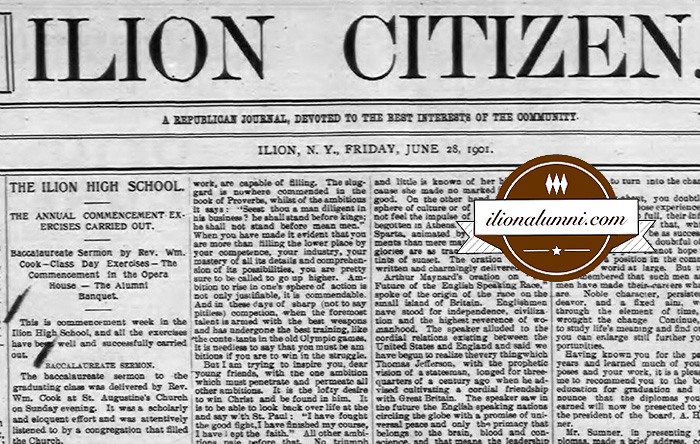
Ilion High School - Class of 1901Ilion Citizen - June 28, 1901THE ANNUAL COMMENCEMENT EXERCISES CARRIED OUT.The Commencement In the OperaHouseArticle 1Source pdf file is here Illion NY Citizen 1900-1902 - 0670.pdf on fultonhistory.com
Baccalaureate Sermon By Rev. Wm. Cook-Class Day Exercises - The Commencement In the OperaHouse - The Alumni Banquet CLASS DAY EXERCISES. Class day exercises where held in Royal Arcanum hall on Monday evening. Before the program opened the junior and senior classes filed in, followed by the members of the faculty, and took seats. After several selections by Thompson's orchestra; Arthur F. Kunze, president of the class, delivered his address, which was well written and delivered in good form. Fred Harter, the orator, had for his subject "Bacon, the Scientist." He showed that Bacon did much for the world in a practical way and contrasted his philosophy with that of Plato, which ended in words, while Bacon's let up to something. The oration had much to commend it. Miss Edith Louise Avery, the historian, related the history of the class in an interesting way and with many humorous touches which were much enjoyed. The class poem by Floyd C. Getman received much praise, all of which was merited. Miss M. Rae Slingerland, the prophetess, displayed much originality in her production. She told of a trip in a flying machine and a visit to the various members of the class fifteen years hence. The humor of the production was greatly enjoyed. In the course of the entertainment John G. Harris rendered two excellent vocal selections and the orchestra played charmingly. After the conclusion of the program the class yells were given. The seats were then removed from the hall and the rest of the evening was given to a social time. In the reception room off the hall ice cream and lemonade were served during the evening. The gathering broke up at a seasonable hour, and all were well pleased with the occasion. Class day was what it should be - a day for the class to review the four years' course and enjoy a final gathering before graduation. COMMENCEMENT. The twenty-eighth annual commencement took place in the Opera House on Tuesday evening. The decorations were mainly daisies, brakes, ferns and rushes, artistically arranged. At the rear of the rostrum was an arch bearing the class motto in Latin: Non scholae aed vitae - "Not for school but for life." The stage was occupied by Prof. Abrams, the graduates and others who were to take part in the exercises. The program follows:
Overture - Raymond ...................................... Thomas Thompson's Orchestra. Miss Mable E. Tucker, the salutatorian, sketched the history of the two rival cities of ancient Greece, Athens and Sparta, which claimed supremacy alike in the science of war and that of government. Athens trained the intellect, developing in man all that was noble and refining, while Sparta paid particular attention to the purely physical, preparing men for war. Sparta fell and little is known of her history because she made no marked impress for good. On the other hand there is no sphere of culture or of science that does not feel the impulse of the artistic sense begotten in Athens. If a nation be, like Sparta, animated by no nobler sentiments than mere material ambitions, its glories are as transient as the golden tints of sunset. The oration was well written and charmingly delivered. Arthur Maynard's oration on "The Future of the English Speaking Race," spoke of the origin of the race on the small island of Britain. Englishmen have stood for independence, civilization and the highest reverence of womanhood. The speaker alluded to the cordial relations existing between the United States and England and said we have begun to realize the very thing which Thomas Jefferson, with the prophetic vision of a statesman, longed for three-quarters of a century ago when he advised cultivating a cordial friendship with Great Britain. The speaker saw in the future the English speaking nations circling the globe with a promise of universal peace and only the primacy that belongs to the brain, blood and conscience, and that means the leadership of the Christian civilization and the progress of the world. The oration was delivered in a clear and well-modulated voice and was much enjoyed. Miss Heiland in her oration, "A Plea for Xantippe" made an excellent defense of that well-known historical character, whose name has been synonymous with that of a scolding, fretful woman. As the wife of Socrates, the greatest Athenian philosopher of his day, she had much to put up with. The speaker maintained that only one side of the story had been told. Socrates did nothing for the support, of his family, leaving his wife and his children in poverty. With all that poor Xantippe had to put up with it was little wonder that she was at times cross and fretful. Miss Heiland's oration was original and entertaining and was admirably delivered. "An Evening in Sudbury Inn" was the title of an oration by Miss Rose Wheelock. She told of a gathering at the old inn and of the stories related by those present. The oration was written in charming style and delivered in a most graceful and entertaining manner. Howard Lester Taylor in his oration on "The Open Door," said the marvelous achievements of the past are but the preparations for the greater progress to which the 20th century points us. This is an age of advancement. There is progress along all lines. What yesterday seemed impossible is today realized. Those who mitigate the crying evils will command the love and respect of the people. Among the problems are the strained relations of capital and labor, immigration and the problem of elevating the masses in the great cities. The speaker urged the members of the class to endeavor to realize the serious responsibilities resting upon them, for before them upon the hinges of the present and opening into the future, bidding entrance, swings the open door. Mr. Taylor's effort was thoughtful and inspiring and oration was well rendered. W. H. Wendell, in his oration on the subject "Should United States senators be elected by popular vote?" argued that the constitution should be amended so as to provide for the election of senators by a direct vote of the people. He pointed out that under the present mode - the election of senators by state legislators - the real choice of the people was often thwarted by the selection of a man who was not the popular choice and who could never be elected by popular vote. Under the present system the use of money sometimes controlled the electors and through deadlocks in legislatures, states were often for a long time deprived of their just representation in the senate. The speaker presented his subject in an excellent manner. Miss Cora A. Taylor, the valedictorian, presented an oration on "Retributive justice in the tragedy of Macbeth." It was a well written analysis of the feelings and passions that animated Macbeth and Lady Macbeth in their career of crime and showed the speaker to have made a close study of what many excellent judges call Shakespeare's greatest tragedy. The great truth set forth in this immortal play is that there will surely be retribution for wrong-doing. Lured on by the demon of unbridled ambition, Macbeth was finally dragged beyond every restraining influence and even beyond hope. Such was the end of his unholy passion to be king. Thought ripens into action, action into habit, habit into character and character into destiny. From such a destiny there is no escape. President A. J. Sumner of the board of education presented the diplomas to the members of the graduating class. All the speakers were heartily applauded and the universal verdict of the audience was that the exhibition was one of the best in the history of Ilion High school. At the close of the speaking Superintendent of Schools Abrams addressed the graduation class as follows: The years that at the beginning of your high school course seemed so long have passed quickly oy and the day of graduation is at hand. Thus one of the objects of year endeavor is realized. Four years ago it may have seemed to some of you that the completion of a full course of study in the nigh school was impossible for you; but one by one, your labors have been performed. Each success has given you added power and confidence, each height reached has enlarged your view, until now quite different are your conceptions and purposes than when you passed out of the grammar school. So it is in life. You most ever look to the starting point to measure your progress. Then it is you may realize from what you have already accomplished the greater success you may reasonably expect to attain. School, after all, is not so much a preparation for life as a vital part of life itself. You may now enter other avenues of activity, but the stream of your existence will only keep on growing wider and wider from the springs of thought and feeling that you shall be able to turn into the channel of your life. As you look about, you doubtless see men and women whose experience seems so rich, their joy so full, their influences great and sustained that, while you wish your life might be as successful as theirs, you draw back, doubtful of yourselves, and say you cannot hope to occupy such a position in the community or in the world at large. But it must be remembered that such men and women have made their - careers what they are. Noble character, persistent endeavor, and a fixed aim, working through the element of time, have wrought the change. Continue, then, to study life's meaning and find out how you can enlarge still further your opportunities. Having known you for the past two years and learned much of your purposes and your work, it is a pleasure to me to recommend you to the board of education for graduation and to announce that the diplomas you have earned will now be presented to you by the president of the board, A. H. Sumner. Mr. Sumner, in presenting the diplomas, made a brief address, congratulating the members of the class upon their accomplishments and reminding them that they were on the threshold of the "open door," of which one orator had spoken. They were about to leave their halls of learning and their teachers and enter upon their course in the "school of life. He wished them all prosperity and believed they would be a credit to their alma mater. The audience was then dismissed with the benediction by Rev. E. F. Hard. The list of graduates follows: Classical course - Latin scientific course - Modern language course - English course - Academic course -
Class Officers - Class honors - Salutatorian, Mabel E. Tucker; valedictorian, Cora Agnes Taylor.

Created and maintained by Aileen Carney Sweeney - Class of 1974
Digital Image Copyright & Copyright © 1997 - 2023 ilionalumni.com
|