Ilion High School - Class of 1898Ilion Citizen - June 24, 1898Class of "Ninety-eight"Article 2Source pdf file is here Illion NY Citizen 1896-1898 - 0144.pdf on fultonhistory.com
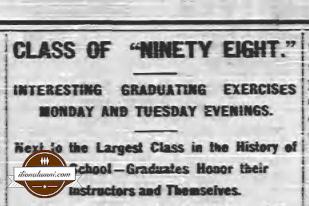
Class of "Ninety-eight" Interesting Graduating Exercises Monday and Tuesday Evenings Next to the Largest Class in the History of the School --- Graduates honor their Instructors and themselves Only once before in the history of the Ilion Union School has it been necessary to divide the exercises of commencement into two evenings but this year, owing to the large class, it was decided to have class-day on Monday evening and the regular commencement exercises on the evening following. The stage was beautifully trimmed with evergreens, foliage plants, white geraniums, and white daisies, which carried out the idea of the class colors --- green and white. Suspended above was the class mott, "Success Through Effort." The boxes on either side of the stage were prettily draped with American flags. At 8 o'clock, Francis Wilber Quaife, the president of the class, introduced the class to the audience, saying, that owing to the large number in the class it had been found necessary to divide the exercise into two programs. He called attention to the exceptional school advantages which we possess and closed his address by expressing the thanks of the class to the teachers of the school, to the board of Education and to the citizens of Ilion. Miss Marjorie Truax, statistician of the class, gave some valuable statistical items of the members, in which she referred to them in a very kind manner, which caused the blush to cover the faces of the young ladies. She gave a complete compilation of shoe sizes, color of hair and eyes, personal traits of character, et. She spoke in an easy manner and at the close, was presented with a bunch of beautiful white roses. Miss Grace Dygert, the secretary and class essayist, chose for her subject "A Country Home," and spoke of the advantages obtained from pure air and healthy surroundings. She is a quiet, pretty little lady, and her effort was one of the best of the evening. Frank A. Bates, the class orator, handled his subject, "Should the Presidential Term be Lengthened," in a scholarly manner, inclining to the belief that a longer term than four years would be more desirable. Miss Rena E. Olds, the class poet, was next on the program, upon the subject, "Past, Present and Future," which was very interesting and was made doubly so by her very pleasant musical voice and good delivery. The class history was shared by Miss Elma H. Gray and Miss Elizabeth A. Myers. Miss Gray's part was entitled, "Voice of the Past" and Miss Myers' "Looking Backward." Both young ladies acquitted themselves with credit. Miss Lena L. Folts and Miss Lela B. Ross divided the honors of class prophecy. It was given in a a talk between them, and the time was placed ten years in the future. They were waiting for a carriage to convey them to the alumni banquet, and in the course of conversation told their experience and mentioned the names of a number of their former classmates. It was found that nearly every vocation was represented. Some had turned out to be actresses, one a salvation army lassie, others peanut venders, cashiers, expert photographers and assistants, a street crossing sweeper, etc. This part of the program was one of the best features of the evening. Miss Bessie Newth read the last will and testament of the class of '92. A document written upon a long roll of legal paper, abounding in lawyers phrases in which they bequeathed all their accumulation of property and money (1c.) to the class of '99. Singing of the class medley by the entire class closed the exercises for the evening, which were listened to with much interest.
COMMENCEMENT EXERCISES At the commencement exercises which occurred on Tuesday evening, the audience was perhaps larger than one the proceeding evening, every seat in the opera house being occupied and much of the standing room taken. The arrangement of the stage and its decorations remained the same as on the previous occasion, and the coldness of the weather rendered the temperature of the crowded hall quite agreeable. Seated upon the stage were Principal J. I. Wood and corps of teachers, A. H. Sumner and Seward Hakes of the Board of Education and Rev. Wm. M. Cook of St. Augustine's church. The program opened by an overture by Wires' orchestra of Herkimer, which furnished artistic music for the evening. A brief religious service was led by Rev. Wm. M. Cook, the audience joining in repeating the Lord's prayer. By way of explanation and preface to the program, Principal Wood stated that it had been the aim and desire of faculty that the subjects chosen for the several essays and orations of the evening might be fully within the comprehension and mental grasp of the respective pupils. That they had succeeded fairly well in that regard, he trusted the several productions themselves would afford ample proof. The first essayist of the evening was Miss Edna M. Shaw, the salutatorian of the class, who had some pleasing words of welcome for the audience in general, and for the class of '99 in particular, which were well received. The subject of Miss Shaw's essay was "A Rocky Mountain Camp," in which she described the vivid manner, a personal experience in camp life in Montana. Although there are many pleasures in camp live, Miss Shaw was of the opinion that there is fully as much prose as poetry found in it. Miss Shaw is a graceful speaker, possessing a pleasing address. Francis W. Quaife, president of the class, chose as the theme of his oration "Magna Carta and Declaration of Independence compared." While regarding the Magna Carta the greater legal document, the speaker very justly held that as the Declaration gave freedom to a nation, it should be regarded as the more important. It is almost certain, he said, that had not the Declaration been promulgated, England would have continued to rule the colonies much longer that she did. England, always jealous of her civil liberties, was herself much interested in the Declaration. Mr. Quaife spoke deliberately, in good voice and manner, and his effort called out hearty applause. "Influences of the Ilion Public Library," was the topic, ably discussed, in the essay of Miss Grace VanGumster, who was the next to appear upon the stage. Miss VanGumster recalled the fact that the idea of a free public library originated in the thought of the members of the alumni of the Ilion high school --- and idea which the munificent gift of Clarence W. Seamans made it possible to carry out. There are now 10,000 volumes on the shelves of the library, and the good which is being accomplished in furnishing pure and desirable literature, can hardly be overestimated. The library affords ample means for extending the education began in the public school, to which it stands next in importance. Culture is the one word which most fully expresses the influence of the library. Miss VanGumster manifested a high appreciation of her subject, and set forth earnestly and in its true light, the value of Ilion's Free Public Library. Her essay was given in a pleasing style which won the warm approval of her hearers. An oration on "Evolution of War," the preparation of which must have cost no small amount of research and careful effort, was given by Arthur W. Hard. He said that the progressive development of the higher nature of man could be distinctly traced through the annals of war as through the records of peace. In the earliest history of the race, men waged war as a pastime and for the extermination of the enemy. Afterwards it became the means of slavery and later of conquest, aggrandizement and acquisition of territory. Still later, it became the means of securing human liberty and the freedom of the oppressed and the slave, until this latest day, wen it has become the privilege of this nation to step between contending parties and make a cruel war in the name of justice and peace. We call a halt to the extermination of the Cuban by the Spaniard. Mr. Hard received generous applause. "The Development of Advertising" was the rather novel subject of the well written and well delivered essay ready by Miss Jessie Northrup. Original in its conception and treated in a pleasing manner, Miss Northrup's effort secured decided favor. With many readers of magazines, she said, it is a question which is more liable to attract attention, a scientific article or the salutation, "Good morning, have you used Pears soap?" The history of advertising was reviewed in an interesting manner and the various modern methods resorted to by advertisers pleasingly referred to. The progress of advertising keeps close pace with the development of science, art and culture. Miss Northrup was made the recipient of a beautiful bouquet of roses. Miss Jessie L. Atherton gave a modest but very charming essay on "A View from Oak Hill," in which the descriptive powers of that young lady were finely displayed. The scenes described were familiar to a large proportion of her audience, and yet were so perfectly portrayed as to hold their closes attention. It is needless to add the Miss Atherton's effort was well received. "Personal Power in Social Life," gave Miss Helen M. Hard a theme which in her hands became intensely interesting. Nothing lives or exists for itself alone. This is a true in mind and spirit as in the material world. Giving is ever the condition of receiving. Personal power is not alone to those who possess wealth, culture, accomplishments, or high educational attainments. It resides in a pure heart actuated by a pure motive. He best helps who gives his fellow man a chance to help himself. Miss Hard exhibited much originality of thought and her essay, one of the best of the evening, was given in a manner which secured the warmest approval of the audience. Miss F. Amy Rankin found in "Some Interesting Features of the Mohawk Valley" a sufficient field of inspiration from which to draw a most finished essay. The magnificent scenery of the valley as well as its many spots of thrilling historic interest were all skillfully touched upon. Miss Rankin's essay was fully up to the high standard of the occasion. "Has the Press too Much Freedom?" was the question propounded an ably answered in the oration given by Harry s. Shepard. With the progress of civilization, the liberty of the press has constantly increased. A free press is a constant factor of liberty, and the freedom a of the people may be traced to the freedom of an untrammeled press. Mr. Shepard's oration showed much thought and was well delivered. The essay which followed, given by Miss Bessie J. Thomas, on the timely topic, "What is Expected of the Girl Graduate," was considered by many, and justly so, as among the ablest efforts of the evening. It is conceded on all hands that the girl is her brother's equal. Nearly every avenue of active life is now fully open to woman and she is permitted and expected to work in any field where she can make herself useful. The world expects the girl graduate to blossom out at once into a full-grown success. Is not the world often to blame for failure by demanding of her too much. The world may expect, however, of the girl graduate of 1898 that she will be honest, courteous, pure and true. Miss Anna M. Powers, evidently a warm admirer of nature, gave a well written essay on "What my Herbarium Tells Me." Miss Miss Alice L. Warren followed with an essay on the "Difficulties of Journalism." She said that to the young people the field of journalism presented a most attractive opening, but that after brief experience, the road usually found to be anything but a bed of roses. Miss Warren's knowledge of newspaper terms and of the hardships of a journalist's career gave proof of quite an intimate acquaintance with the subject. The essay was original and well delivered. Miss Alice L. Warren followed with an essay on the "Difficulties of Journalism." She said that to the young people the field of journalism presented a most attractive opening, but that after brief experience, the road usually found to be anything but a bed of roses. Miss Warren's knowledge of newspaper terms and of the hardships of a journalist's career gave proof of quite an intimate acquaintance with the subject. The essay was original and well delivered. An oration and valedictory was then delivered by H. Kirkland Smith. The subject of his oration was "Alaska." He reviewed the situation from its purchase to the present time and prophesied that it would become to America what Australia was to England. In his valedictory he expressed thanks to the board of education, to the citizens of the village, to Mr. Powers for his care and thoughtfulness, to Prof. Wood and the faculty for their uniform kindness and help throughout their school life. He addressed the class of '99 in a few well chosen words. As he was speaking the class of '98 came onto the stage and joined in a semicircle behind him, and his concluding remarks were addressed to them. The class ode was then sung with much feeling, after which Prof. Wood gave a brief address before handing them their diplomas. He said; "There were few leaders in life but many followers. The leader is the brainy man of character, the man of original thought, of energy, of nerve and of more or less of the spirit of venture. Let my parting expression to you," he continued, "that you be leaders, not followers." The diplomas were then presented, the benediction pronounced by Rev. Wm. Cook and the class of '98 were free to go their several ways as life and duty call them.

Created and maintained by Aileen Carney Sweeney - Class of 1974
Digital Image Copyright & Copyright © 1997 - 2022 ilionalumni.com
|