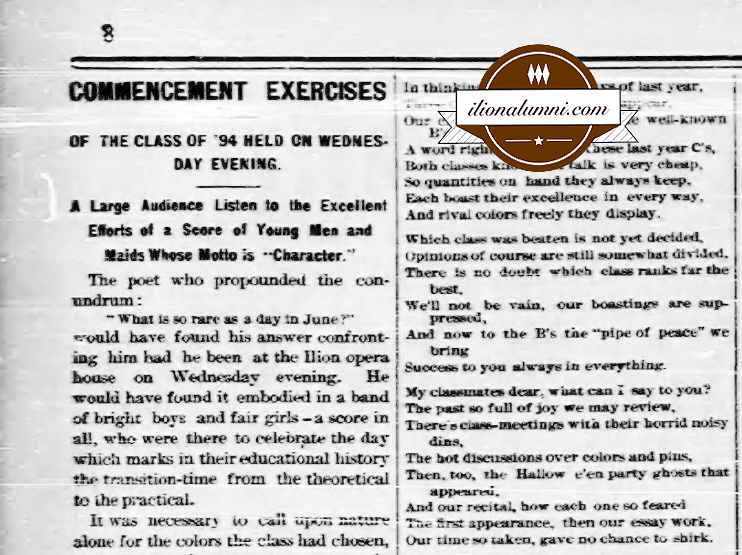
Ilion High School - Class of 1894Ilion Citizen - June 22, 1894COMMENCEMENT EXERCISESOf the Class of '94 Held on Wednesday EveningArticle 1Source pdf file is here Illion NY Citizen 1893-1896 - 0701.pdf on fultonhistory.com
A large Audience Listen to the Excellent Efforts of a Score of Young Men and Maids Whose Motto is "Character." The poet who propounded the conundrum: "What is so rare as a day in June?" would have found his answer confronting him head he been at the Ilion opera house on Wednesday evening. He would have found it embodied in a band of bright boys and fair girls - a score in all, who were there to celebrate the day which marks in their educational history the transition-time from the theoretical to the practical. It was necessary to call upon nature alone for the colors the class had chosen, and white and green were present in profusion. On an arch of evergreens spanning the state was displayed in white the letters of the Greek word meaning "character," the class motto. The opera house was filled to overflowing, as is usual on such occasions. The exercises were opened with the invocation by Rev. W. C. Taylor. Then, preceding the salutatory Rath's orchestra of Utica, led by Mme. Rath, rendered Boildien's overture from the "Calif of Bagdad." Herbert Gough the salutatorian extended a cordial greeting to the assembled audience and the class of '95. In introducing the class of '94 he said, "We do not claim to possess the brilliancy of Demonsthenes nor the wisdom of Solomon we only claim that during our course in school we have endeavored to do our work in a manner the satisfactory to our instructors and beneficial to ourselves." His oration "What elements influence character," clearly proved that education has a stronger force in the development of character than anything else. Other influences are proper reading matter, climate, ideals and civilization, which is the outcome of Christianity. Miss Rae Russell's subject was "The Workman Dies, but the Work goes on." Earth's denizens were compared to workmen, the frequency of great results from comparatively little events was shown, as was the fact that "the hand that rocks the cradle rules the world," and Miss Russell drew an excellent lesson of careful living, so that "those coming after us may not be injured, but rather helped to a better life." In "A Plea for the Jew," Miss E. Jennie Williams described the civilization contemporaneous with the Theocracy and told of their influence in financial and educational circles in all the countries into which they have been dispersed. It was a well written plea for more favorable consideration of the despised Semitic race. "Mens sana in corpore sano," was the thought underlying Howard L. Doty's excellent oration on "The Necessity of Physical Training in our Schools." He told of the physical weakness too often consequent on mental strain, and advocated the establishment of a gymnasium in connection with every public school. "Woman of the Nineteenth Century," was Miss Genevieve R. Giblin's subject. She told of the position occupied by women in ancient and medieval ages and of her success in various professions in more recent times. She contended that the "survival of the fittest" means the supremacy of the fin de siecle female. Very cleverly written was Miss Blanche Ringwood's "American Woman in Literature," telling of the first entrance of woman upon this field and the important place in that field which she now fills. In "Life's Battlefields" Miss Clara Atherton pictured life as a contest, and laid stress upon the real importance of the seemingly insignificant part played by the humble individual "in the ranks." "The race is not always to the swift, nor the battle to the strong." The greatest contest is with ourselves and "He that ruleth his temper is greater than he that taketh a city." It was a well-written and well-delivered production. William J. Thistelthwaite considered both sides of the question "Should the United States Assume a Protectorate over the Western Hemisphere" presenting in excellent style, most of the arguments for and against a Pan-American republic. In an excellent voice Miss Elizabeth Illig told of the good results which sometimes come from "Our Failures," most of which are due, she thought, to lack of ambition or perseverance, bad advice or lack of tact. She amplified upon excellence of the old adage, "If at first you don't succeed, try, try, again." The class poetess, Miss Emily Pettigrove, then read her excellent production, as follows: Our School Days
Our school days - in the average students mind
At first we dared not glance across the aisles,
We struggled onward through the A, B, C's,
"Brick building dignity" meant far more care,
A word right here about these last year C's.
Which class was beaten is not yet decided,
My classmates dear, what can I say to you?
Professor and our teachers her to-night
The future yet untried - The school of life.
Life's school days, life's examinations held, Harry P. Lewis, in his oration on the "True Dignity of Nations," said that Bacon's definition of war is not applicable now, that the warlike ideal is a mistaken one, and that freedom is a requisite of national dignity. His antitheses were excellent and his voice good. "Life's Micawbers" was Miss Anna R. McGarry's subject and her delineation of the numerous people whom we meet who might have posed for Dickens' immortal character was very good. The class history from the pen of Edith G. Ross, was decidedly interesting and amusing and kept the audience in good humor while Miss Ross occupied the stage. "We, Us & Company" translated, showed that the company is always the silent partners and of course this meant the young lady members of the class, while the "We, us" were the young gentlemen. The ups and downs, joys and sorrows, of the class as a whole and individually were delightfully pictured and the fair historian was very warmly applauded. Miss Florence E. Doty had a resourceful subject in "Shakespeare's Intellectual Women," and showed considerable skill in the analysis of the characters portrayed by the great master. Her pen picture of Portia deserves more extended mention than we can give it. In a well-written essay Miss Margaret C. Spedding told of the history and prevalence of that "Slavery to Fashion," which is now so much in evidence, and over which she deprecated as the "destroyer of domestic peace and the foe to social enjoyment." Robert B. Schmidt's rendition in a well modulated voice, of his oration on "England during the Rebellion" was a comprehensive review of the historical events which led to the arbitration of the Alabama claims. Miss Fannie Steele showed the truth of the fact "Nothing Is Lost" and that the imperishability of influence should be an incentive to casting bread upon the waters. It was a good essay. nd manner was made the recipient of the two fine bouquets, as well as a generous share of applause. Miss Agnes Owens showed a proper estimate of the sphere of good journalism in her essay on "The Value of Newspapers," Hers was a bright paper, and read in good style. The class prophecy "An Unpublished Chapter of the Sketch Book," fell to Nellie Trueman and as a prophetess she is a great success. In 1900 she discovered her classmates in various walks of life, one the wife of a lawyer, another an eminent M. D. in the Metropolis, other teachers of languages in a leading seminary, still another, one of the popular writers of the day who, when not busy with her writings, assists her husband who was a member of the class of'94, but in 1900 is a talented divine. Nurses, traveling salesmen, a star in the operatic world, missionary, dentist, art students, bank treasurer, a lady lawyer, school teachers and women suffragists are some of the many professions which in 1900 are filled by the class of '94. The valedictory by Estella A. Leach was one of the gems of the evening. Her essay was on Social Geometry. Geometry produces accuracy and also develops the reasoning faculties, two very essential elements. To the Board of Education, Janitor Powers, the Faculty, class of '95 and her classmates, Miss Leach spoke very feelingly. Then, taking their places on the rostrum, the class sang their pretty ode. Principal Wood made a brief but earnest and thoughtful address, the diplomas were presented and with the benediction by Rev. R. E. King, the commencement exercises of the class of '94 were concluded. The musical numbers of the program by members of Rath's orchestra of Utica, were good. Mme. Rath's violin solo, Dancla's "Fantasic," being encored. Music-lovers regretted that the time-table didn't permit the orchestra to finish their program. All in all, the exercises were very successful, and the class of '94 while not as strong numerically as that of last year, have reason to be proud of their record and the school which on Wednesday evening they so credibly represented.

Created and maintained by Aileen Carney Sweeney - Class of 1974
Digital Image Copyright & Copyright © 1997 - 2022 ilionalumni.com
|