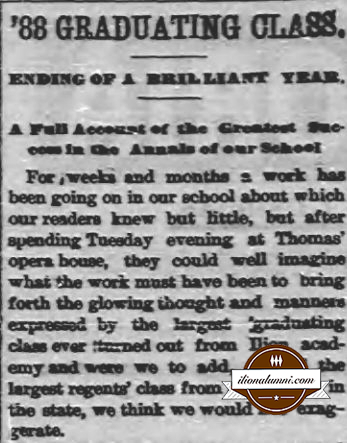
Ilion High School - Class of 1888Ilion Citizen - June 29, 1888'88 Graduating Class Ending a Brilliant YearArticle 2Source pdf file is here Illion NY Citizen 1888-1890 - 0978.pdf on fultonhistory.com
'88 Graduating Class Ending a Brilliant Year A Full account of the Greatest Success in the Annals of our School For weeks and months a work has been going on in our school about which our readers knew but little, but after spending Tuesday evening at Thomas' opera house, they could well imagine what the work must have been to bring forth the glowing thought and manners expressed by the largest graduating class ever turned out from Ilion academy and were we to add, one of the largest regents' class from any school in the state, we think we would not exaggerate. Thomas' opera house never presented a more attractive appearance than Tuesday evening, with the beautiful display of tropical plants, flowers and baskets in artistic designs, filled with sweet scented roses, the Greek motto ... in evergreens on a white back ground and a bell of flowers suspended over the stage made a picture most pleasing. Thomas' opera house never presented a more attractive appearance than Tuesday evening, with the beautiful display of tropical plants, flowers and baskets in artistic designs, filled with sweet scented roses, the Greek motto ... in evergreens on a white back ground and a bell of flowers suspended over the stage made a picture most pleasing. The opera house was crowded in every part to overflowing but the cool evening made it possible for extreme quietude to prevail during the exercises that lasted nearly three hours. At precisely five minutes after eight o'clock Prof. White called upon Rev. D. F. Pierce of the M. E. church who offered an earnest and thoughtful prayer, invoking divine blessing upon all, especially the class of '88. At the close of prayer the class formed a semi-circle about the stage and with Prof. Raleigh of Utica, at the piano, opened with a song, "the Greeting" admirably rendered with force and sweetness of well blended voices. Owing to the death of the salutatorian, W. W. Benton, John H. Myers opened the entertainment with a well written and well rendered oration, sowing the influence of national songs on patriotism. By these lyrics only he claimed, many remarkable events of history daring and pathetic exploits, had been preserved. Not until the war of 1812 were our national songs truly American and the civil war he thought made the largest increase to our patriotic poetry. His part was most admirably taken, and universally commended. Myths and their Meaning by Miss Nettie O'Hara was a pleasant and interesting interpretation of some of the stories of mythology. She spoke of the true import of the story of Proserpina and Cupid and Psyche. The question of Social Problems was well treated by Carl Joerissen. He spoke especially of the difficulties of harmonizing the antagonistic elements found in varions races, Europeans, Mongolians and Africans, all trying to make this country their home. He also mentioned the impractical work which our schools had done but thought industrial education would remedy this evil. He had no respect for the opposition to general education offered by the millionaire whose educates his children in schools of fashion and by the man of leisure without children. Popular Delusions, by Miss Grace Abbott was one of the best essays of the evening. She discussed many of the more common superstitions. For example: Evening red and morning gray, dressing the left foot first, placing the right foot first when entering a residence, the lucky horse shoe, and the customs of the Germans to carry a piece of home made bread with them to their new residence to drive away home sickness. Miss Abbott by her pleasant manner carried her audience with her from first to last. Thomas Ringwood in his treatment of the Future of the United States showed his precocity of intellect by a very clear perception of the true conditions and requirements of our country. He spoke well on the subject of the navy, woman's suffrage and corruption in legislation. Diamond Analogies by Mae I. Wilcox was a very enjoyable production, both in the way it was rendered and the matter. She compared different types of character to the rose, table and brilliant diamond and the shoddy character was well illustrated by the cheap French paste, and the retired person of sterling worth was well compared with the gem which the dark unfathomed ocean bears. Frank Segur showed very clearly the value of education as regards national prosperity. He evaded what is trite upon this subject and by originality of thought interested his audience. He compared ancient education, only physical, with the modern three-fold education and claimed that the loss of some of the historic art and genius was due to the fact that the masses were not educated. To meet the requirements of our intricate civilization he thought that general education would be much more needed in the future than it was in the past. Sanford Rasbach's Glance at Philology was decidedly unique and being so different from the ordinary graduating oration all were much interested in it. He displayed tact in his analysis of proper names and claimed that language would have a new meaning if much more attention was given to what words say. The harmony between the meaning of the name and the character of the individual was very marked in the case of Xenophon, Alexander, Demosthenes and Christopher Columbus. His personal appearance upon the state was good. Our Responsibilities by Miss Jochmus was listened to with increasing pleasure. This lady has a good personal presence and her manner was easy. She evidently does not believe in the idle, poodle-dog existence of women. She claimed that the girl of the period has a higher sphere of usefulness than to play the fashionable coquette. She thought women had made gossip and art, and as a man without a calling is despised so should it be with woman instead of the reverse being true as now. William Hunter's view of the value of a vote in the affairs of our government was thoroughly appreciated. In view of the corruption practiced at the ballot box he thought Herbert Spencer right when he said the government of the United States is a hundred years in advance of its subjects. The effort by Morrell Beals was considered one of the finest of the evening. The presence of the audience seemed to inspire him to do his best and he made a very excellent presentation of his subject, "I will and I won't." He was fortunate in his choice of characters for illustrating his theme. He claimed that this decision of character was one of the chief causes of Grant's success and the want of it the cause of Benedict Arnold's treachery. His figure in which he made I will, and I won't the chains of the rudder and reason the pilot, was very good. Fred Joerissen one of the classical scholars showed his appreciation of Greek by an excellent oration upon that subject. His arguments were strong and logical, and his manner proved him sincere in his utterness. He claimed for Greek the first place in the power to develop the intellect. It enriched the vocabulary of the English student, furnished the meaning of scientific names, cultivated the tase, gave a practical acquaintance with life and gave excellent preparation for the study of mathematics. That many were not thorough Greek scholars at the end of their course did not prove that they had not received invaluable benefits from its study. Dough, although a rare subject, was skillfully presented by Miss Hattie Bruder. Her manner and vim assisted much in the pleasure afforded by this production. Dough was shown to be less ornamental than useful and too common to be wonderful and unreliable as to its picturesqueness. Yet, lacking so much in the elements of beauty, dough was extremely fascinating to persons even of refined taste. Throughout the entire essay ran a vein of sarcasm or humor which was much appreciated. George Brand captured the house by his Parody on Poe's Raven, "The Regent Friend." As George sat in his study, upon a midnight in November, a gentle tapping was heard at is door which did not prove to be a raven but a Regent's paper, which having gained entrance perched upon a dictionary and threatened to flunk him evermore. At length in his alarm he asked: "Prophet," said I, somewhat rattled, rattled more the more it prattled, Mr. Brand delivered the parody with well chosen gestures and made it one of the most pleasing parts of the program. Miss Bertha Bellinger's essay on the Language of the Countenance was one of the best productions ever presented in the opera house. Each movement was full of expression and in perfect keeping with the thought. She made the expression of the face one of the most important means of thoughtful expression, more reliable even than spoken or written language. She used as an illustration and a very pertinent one too, the instance of the youthful artist who painted the face of a child of heavenly beauty. Long years after the same artist looking for a face which should be the opposite of this face of purity and innocence painted one found in the haunts of vice, the face was that of a loathsome being whose features were marked with lines of lust and guilt and yet the person was the same who years before had borne the face of that child of exquisite beauty. Samuel Allston of fine personal presence, entertained his audience in a manner worthy of any occasion. He showed conclusively the advantages of a liberal education to the citizens of a republic above all other forms of government. That there were not more, liberally educated he thought was due to the fact that its value was not generally understood. The poet, Philo R. Squire is worthy of all commendation for the work of his muse. He may have been unfortunate in his choice of subject, as a large majority of the audience were not classical students but to the ordinary observer it was apparent that his poem was the language of passion enlivened by a vivid imagination and full of intense thought and this is true poetry. The essay by Miss Maud Rix was in no respect "No Essay." She pictured very vividly the experience of a young girl "grad," in her effort to write an essay. Many in the audience enjoyed this production much because of its witty allusions and Miss Rix's ease and grace of delivery. The revelating given by the prophet were obtained by a machine known as the mantiograph. Miss Colburn is considered the Samantha of the class, and her natural humor disposed of many of her classmates in a very ludicrous manner. Some of the class of '88 may not be satisfied with their future prospects but all are pleased with the work of the prophet. The Chronicles of '88, by Gene Ross, one of the most popular members of the class, were very ingeniously expressed in the language of Bunyan's Pilgrims Progress. Of the History it can be justly said that none was ever more enjoyed than this of '88. The instrumental duet, La Baladina, by Misses Ross and Rix delighted the audience. Miss Ross is considered one of the most accomplished musicians ever graduating from our academy. Herbert H. Myers, the valedictorian closed with as good record as his previous work in the school would indicate. In his oration on Magnets he showed in well chosen words the power of the silent, intangible influence of man. In his valedictory he acquitted himself with deserved honor, and with his eloquence moved some of the audience to tears. The record of this class is ahead of any previous class that has graduated at the Ilion academy. Of the twenty one members, nineteen have earned Regent's diplomas and of the two who did not, one only required two more credits on his examination in geometry and the other is short one subject. At the close of the valedictory, Prof. White addressed the class before him giving them words of cheer and good advice and complimenting them for the zealous manner in which they had applied themselves in preparing for this occasion. This part of the program was followed by the parting song by the class. Just at the close tow members of the class retired soon to return bearing a beautiful silver water set when Samuel Allston in behalf of the class of '88 presented it to Prof. White with well chosen words. The professor, ever ready for any emergency, made a most timely response thanking them for the gift. Seated about the stage were Rev. D. F. Pierce of the M. E. church, Rev. A. B. Sears of the Baptist church, board of education and teachers of the school. Prof. White has now closed his second year with us and during that time has worked earnestly and faithfully for the good of the pupils under him. After listening to the masterpieces of the unusually large class that graduated under his teachings, all were universal in their praise of him as a teacher. The result of this faultless evening's exercise must be a source of pleasure and gratification to the professor and his teachers as it was to the parents and friends o the class of '88. The stand of our school is one of the highest in the state and its present lofty position under the able corps of teachers is a credit to our progressive board and one which the citizens of Ilion deeply and earnestly feel. The occasion was in one respect a solemn one for in March one of the brightest ones, W. W. Benton, jr. salutatorian, was taken away and on this occasion only a life-like portrait was with them here. It was placed upon an easel on the stage under which was a broken wheel made of white flowers. When his name was mentioned tears were brought to the eyes of his classmates and his low was as fresh in the minds as though his death was but of a day.

Created and maintained by Aileen Carney Sweeney - Class of 1974
Digital Image Copyright & Copyright © 1997 - 2024 ilionalumni.com
|